
Walk into any kitchen, bakery or food packaging supplier and you’ll hear these papers called all sorts of names: parchment paper, baking parchment, baking paper, butter paper, greaseproof paper. Some people use the terms interchangeably. Others insist they’re completely different products.
So, is parchment paper the same as butter paper? The short answer is: sometimes, but not always. It depends on where you live, who you ask and, most importantly, how the paper is made. In this guide, we’ll clear up the confusion, explain the real differences, and help you choose the right paper for your kitchen or business.
The Short Answer
Parchment paper and butter paper are closely related, but not always identical.
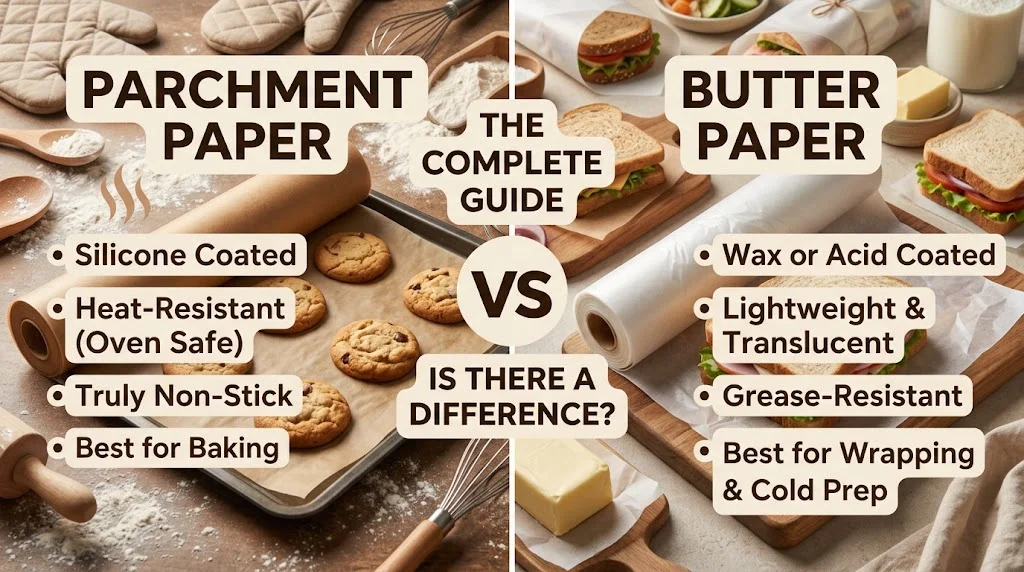
- Parchment paper (also called baking parchment) is a heat-resistant, non-stick paper, usually treated with silicone.
- Butter paper is a common name for a thin, grease-resistant paper traditionally used to wrap butter and food. It’s often uncoated and is essentially a type of greaseproof paper.
The confusion comes from the fact that, in many regions, sellers use “butter paper” as a catch-all label for any translucent baking or wrapping paper, including products that are actually parchment. That’s why it’s important to check what’s on the packaging rather than relying on the name alone.
What Is Parchment Paper?
Parchment paper is a cellulose-based paper that has been treated to make it:
- Non-stick, so cakes, biscuits and bakes lift off easily
- Heat resistant, suitable for oven use within the temperature range printed on the pack
- Moisture and grease resistant, so it doesn’t soak through
Most modern baking parchment is coated with a thin layer of silicone, which gives it the non-stick finish. Traditional vegetable parchment is made by treating paper pulp so the fibres become dense and resistant to grease and moisture.
In the UK, you’ll most often see it labelled as baking parchment or baking paper.
What Is Butter Paper?
Butter paper gets its name from its historic use: wrapping butter, cheese and other fatty foods. It’s a thin, translucent paper that resists grease without needing a heavy coating.
In practice, butter paper is usually:
- Greaseproof paper made from densely beaten pulp
- Lightly or un-coated, depending on the manufacturer
- Less heat tolerant than silicone-coated baking parchment
- Widely used for wrapping, lining and food presentation
In parts of South Asia, “butter paper” is also the everyday name for the paper people use to line cake tins, so you may find some products sold under this name that behave like parchment. Again, the label on the pack matters more than the name.
Parchment Paper vs Butter Paper: Key Differences
| Feature | Parchment Paper | Butter Paper |
|---|---|---|
| Main purpose | Baking and cooking | Wrapping and lining |
| Coating | Usually silicone-coated | Often uncoated |
| Non-stick | Yes | Limited |
| Heat resistance | High (check the pack) | Lower, varies by product |
| Grease resistance | Excellent | Good to excellent |
| Typical uses | Baking trays, cake tins, roasting | Wrapping butter, sandwiches, pastries |
| Reusable | Often a few times | Usually single use |
| Recyclability | Coated types are generally not recyclable | Clean, uncoated paper may be |
The main takeaway: the coating is what separates the two. If a paper has a silicone layer, it behaves like parchment. If it relies on dense paper fibres alone, it behaves like butter paper or greaseproof paper.
Can You Use Butter Paper Instead of Parchment Paper?
It depends on what you’re doing.
When it’s usually fine
- Lining a cake tin (greased lightly) for low to moderate oven temperatures
- Wrapping food such as sandwiches, pastries or cheese
- Separating layers of biscuits, cakes or burgers
- Resting dough or sweets on a tray
When to be careful
- High-temperature baking or roasting, where uncoated paper may scorch or darken
- Sticky bakes such as meringues, macarons or caramel, which can cling to uncoated paper
- Long cooking times, where the paper may dry out and become brittle
If you’re not sure, check the manufacturer’s maximum temperature on the packaging, and avoid placing any paper in direct contact with an oven element or flame.
Can You Use Parchment Paper Instead of Butter Paper?
Almost always, yes. Baking parchment works well for wrapping and lining, and it handles heat far better. The trade-offs are that it can be more expensive and, because of the silicone coating, harder to recycle. For wrapping cold or room-temperature food, uncoated butter paper or greaseproof paper is often the more sustainable choice.
Is Parchment Paper the Same as Greaseproof Paper or Wax Paper?
These three get mixed up constantly, so here’s a quick guide:
- Parchment paper: Heat-resistant and non-stick, usually silicone-coated. Best for baking.
- Greaseproof paper: Grease-resistant through its dense fibres. Good for wrapping and lining. Often the same thing as butter paper.
- Wax paper: Coated with wax. Fine for wrapping and cold use, but not oven safe, as the wax can melt or smoke.
Never use wax paper in the oven. If you’re swapping papers, parchment is the safest all-rounder.
How to Tell Which Paper You Have
If your paper isn’t clearly labelled, try these checks:
- Look at the packaging. Reputable products state their coating, food safety and temperature rating.
- Feel the surface. A smooth, slightly slippery finish suggests silicone. A matte, papery feel suggests an uncoated paper.
- Check the heat rating. A clearly stated oven-safe temperature usually points to baking parchment.
- Ask your supplier. If you’re buying in bulk or for a business, ask for the product specification sheet.
Avoid guessing, particularly when using paper at high oven temperatures.
Which One Should You Choose?
Choose parchment paper if you:
- Bake regularly and want a reliable non-stick surface
- Roast or cook at higher temperatures
- Work with sticky or delicate bakes
Choose butter paper or greaseproof paper if you:
- Mainly wrap, serve or present food
- Want a more natural, uncoated paper
- Prefer something easier to recycle or compost, where local rules allow
Tips for Food Businesses
For bakeries, cafés, delis and takeaways, the right paper does more than protect food. It’s part of your brand.
- Match the paper to the job. Use baking parchment for the oven and greaseproof or butter paper for wrapping and serving.
- Choose food-safe, certified paper. Make sure it’s suitable for direct food contact.
- Consider FSC-certified paper from responsibly managed forests.
- Print your branding. Custom printed greaseproof paper turns everyday packaging into a memorable brand touchpoint.
- Think about disposal. Uncoated papers are generally easier for customers to dispose of responsibly than coated ones.
The Bottom Line
Parchment paper and butter paper are not always the same, but they’re closely related. Parchment is the non-stick, heat-resistant choice for baking, while butter paper is a traditional grease-resistant paper best suited to wrapping and lining. The name on the label can be misleading, so always check the coating, heat rating and food safety information before you buy.
Looking for the perfect paper for your bakery, café or takeaway? Browse our range of custom printed greaseproof and baking papers at Custom Papers UK and create packaging that protects your food and promotes your brand.
No, butter paper and baking paper are not always the same. Baking paper, also known as parchment paper, is commonly silicone-coated to provide a non-stick surface for baking. Butter paper is generally used for wrapping food and light food preparation, depending on its specification. Always check the intended use before choosing either paper.
Not all butter paper is suitable for baking. Some grades are designed for wrapping and food preparation rather than oven use. For baking cakes, biscuits, cookies and pastries, choose baking parchment that is suitable for your oven temperature and follow the manufacturer’s instructions.
Many silicone-coated parchment papers provide a non-stick surface on both sides, making them suitable for a range of baking applications. However, the coating can vary between products, so check the manufacturer’s specifications before use.
Yes, butter paper can be suitable for direct food contact when it is manufactured for that purpose. Always choose food-grade paper that meets the requirements of your intended application, particularly when using it for commercial food packaging.
Yes, baking parchment can be used in the oven within the maximum temperature specified by the manufacturer. Keep it away from heating elements and open flames, and follow the product’s safety instructions for the best results.
Recycling parchment paper depends on its coating, condition and local recycling facilities. Silicone-coated parchment is generally not accepted in household paper recycling. Check your local council’s guidance before disposal. You can also read our guide on whether greaseproof paper is recyclable for more information.
Butter paper and standard greaseproof paper can be more affordable than baking parchment, depending on the material grade, coating, size and order quantity. Baking parchment may cost more because of its non-stick properties and suitability for oven use. Compare the specifications and intended applications when choosing the right paper for your business.